If you are visiting as parent or grandparent of New Zealand citizen or resident
Parent Resident Visa Assistance — New Zealand
Bring your parent to New Zealand — start with a plan that holds up.
The sponsor's income evidence, the ballot timing, and a 10-year financial commitment that outlasts the visa itself — we help families work through every stage of the Parent Resident Visa process.
The basics
What is the Parent Residence Visa?
A residence-class visa from Immigration New Zealand for a parent sponsored by an adult child who is a New Zealand citizen or resident — granted through an Expression of Interest, a ballot, and an Invitation to Apply, with a 10-year sponsor financial commitment that continues beyond the grant.
Residency pathway
Residence-class parent visa. The sponsor-income (rather than investment) pathway in the parent category.
Eligibility
Applications proceed via Expression of Interest, ballot selection, and Invitation to Apply within a fixed window — measured in months, with no extensions.
Sponsor
The sponsoring adult child must meet residency, ordinary-residence, and income requirements, tested across NZ tax years using IRD records.
Sponsor
Sponsorship can be solo, joint with the sponsor's partner, or shared between two adult children of the same parent.
Compliance
A grant triggers a 10-year financial-support commitment from the sponsor — a long-duration legal obligation that runs years beyond the grant itself.
Dependency
Dependent children of the applicant are not included. A parent with dependent children generally cannot apply on this basis.
Parent Resident, Parent Retirement, or visitor?The right pathway depends on the sponsor's income, the family's investment position, the length of stay needed, and whether residence is the goal. Talk to us so the right one is in play.
On the other side of the paperwork is a parent living in New Zealand with the right to stay, regular time together as a family, and a plan that runs past the grant of the visa into the years that follow.
When our help makes a difference
Where we step in — and what we do
Some immigration processes are approved without much friction. Some situations carry real risk of delay, hard pushback or decline.
Real cases · Illustrative
Situations we've helped with
Every case is different. These are illustrative and don't guarantee a particular outcome.
Avoidable problems
Common risks — and how to reduce them
Visitor Visa applications can be declined or delayed for reasons that are sometimes avoidable with better preparation.
- 01High impact
Genuine intentions assessment
Weak ties to a home country, inconsistent travel history, or vague explanations of the purpose of a visit can raise concerns. A well-prepared application addresses these points directly with supporting evidence.
- 02High impact
Insufficient financial evidence
Bare-minimum bank balances, unclear income sources, or missing sponsorship documentation can lead to requests for further information or decline.
- 03Medium impact
Health and character flags
Applicants from countries without a low TB incidence may need a chest X-ray. Those with criminal history may need police certificates. Out-of-date evidence delays processing.
- 04Medium impact
Passport validity
Your passport must be valid for at least three months beyond your planned departure date. Travelling on a passport close to expiry can result in being refused boarding or refused entry at the border.
- 05High impact
Misrepresentation
Providing false, misleading, or incomplete information — even unintentionally — can result in decline, and may affect future visa applications.
- 06Manageable
Timing
Applying too close to your intended travel date, or failing to apply for an extension before your current visa expires, creates complications that are difficult to resolve.
Important constraints
What the Parent Residence Visa doesn't cover
The Parent Resident Visa is the sponsor-income pathway in the parent category. If a different parent pathway suits, or you need short-term visit options instead, that's the right starting point.
Not permitted
The Parent Resident Visa is the wrong fit if any of these applies.
Lodging under the wrong pathway wastes time and money. We'll tell you up front if a different parent visa fits your situation better.
Apply through investment rather than sponsor income
See Parent Retirement Resident Visa.
Apply with dependent children on the application
Dependent children are not included. A parent with dependent children generally cannot apply on this basis.
Apply for a long-duration visitor visa
See Parent Boost Visitor Visa.
Apply for a multiple-entry visitor visa
See Parent and Grandparent Visitor Visa.
Get tax or estate advice on the move
That sits outside immigration law. We can flag the point at which to bring in a tax adviser or estate planner.
Find the right pathway
Other options we can also help with
If a different immigration process fits your situation, we can take you there directly.
Working with us
What the process looks like
We will guide you step by step on your Parent Residence Visa process, from start to finish.
Initial enquiry
Short discussion to understand the family's situation, the sponsor's position, and whether the Parent Resident Visa pathway is the right route or another parent pathway fits better.
Service engagement
Letter of engagement signed, invoice paid. We open the file and map the timeline against EOI submission, ballot windows, and any current visa expiry.
Evidence preparation
We work through the sponsor's income evidence (IRD-based), ordinary-residence documentation, applicant's medical and police clearances, English-language evidence, and any partner documentation — so the file is ready for the Invitation-to-Apply window when it arrives.
Lodgement
We submit the Expression of Interest, then the substantive application within the ITA window once selected. We file on your behalf and confirm receipt with INZ.
Monitoring & response
If INZ requests further information mid-process, we draft the response with you — promptly, in the right form. We also track any circumstance changes during the EOI-to-decision window.
Decision & next steps
We walk you through the outcome. If granted, we explain the residence conditions and the 10-year sponsor financial commitment. If declined, we work through reasons and your realistic options.
FAQ
Frequently asked questions
A Parent Resident Visa application involves sponsor income evidence tested against IRD records across multiple tax years, an Expression of Interest that needs to be consistent with evidence the family can later produce, a fixed Invitation to Apply window with no extensions, and a 10-year financial-support commitment that is a legal obligation rather than a formality. Immigration-law support covers each of those stages — preparing sponsor-side documentation in the form Immigration New Zealand accepts, coordinating the evidence across joint sponsors or self-employed income structures, planning for changes in circumstances across the application period, and presenting any health or character history accurately and completely. A short initial discussion can help map out where the application sits and what preparation looks like for your family’s specific situation.
At the Expression of Interest stage our focus is on whether the Parent Resident Visa is the right pathway, whether the sponsor configuration is sound, and whether the evidence that will later be required can actually be produced. An Expression of Interest submitted on a weak or inconsistent basis tends to create problems months later rather than at the point of submission. Once an Invitation to Apply is issued, the work shifts to assembling the full application within the window Immigration New Zealand has set, lodging on time, and responding to any requests for further information during assessment. Because that window is fixed and extensions are not offered, the planning done before it opens generally matters more than the work done inside it.
Yes. These are the situations where sponsor-side documentation requires the most care. Immigration New Zealand accepts only IRD-generated records for self-employed sponsors, and income distributed through a trust or company needs to be presented in a way that fits the sponsor configuration being used. The earlier we can look at the income position, the more room there is to structure the evidence cleanly across the relevant New Zealand tax years, rather than retrofitting documentation once an Invitation to Apply has already been issued. We can also flag where specialist accounting or tax input would be helpful alongside the immigration-law work.
It depends on what changes and when. An income movement, a change in the relationship between joint sponsors, a job change, or a relocation can each affect the application in different ways. In some situations the sponsor configuration can be adjusted; in others the sensible step is to wait, to look at a different pathway, or to disclose the change and prepare a considered response if it becomes relevant to the decision. We work through the options in the specific situation rather than assuming a single answer applies to all cases. Changes in sponsor circumstances are one of the most common reasons families benefit from having legal support already on the matter when the change occurs, rather than seeking advice reactively.
The sponsorship involves a 10-year financial-support commitment from the sponsor (and any joint sponsor) to the sponsored parent, given as part of the application and running for years beyond the grant of residence. It is a legal obligation rather than a statement of intent. What we can do is explain how that obligation is framed, how it interacts with other family arrangements (a sponsor’s partner, their own assets, their estate plan, any trust structures), and what sponsors typically weigh before taking it on. What we do not do is quantify enforcement outcomes or predict how any particular future situation would be treated — those depend on case-specific facts and on policy settings that can change. Families who want a fuller walkthrough before committing often find the sponsor readiness guide on this page a useful starting point.
Options depend on the grounds of the decline and the stage at which it occurs. They may include a reconsideration request, a reference to the Immigration and Protection Tribunal, a section 61 request in appropriate circumstances, or consideration of a different visa pathway. None of these are automatic, and the right step depends on whether the concern sits in the evidence, in eligibility, in health or character, or in a procedural matter. We talk through the options with the specific decline in view, rather than assuming one route is the answer, and we can continue on the matter where we have been involved earlier in the process. Where an appeal or tribunal step is relevant, our Immigration and Protection Tribunal appeals service page is a useful starting point.
Yes. A neutral options review is usually the first step where a family has not already settled on a pathway. The Parent Resident Visa, the Parent Retirement Resident Visa, and the Parent Boost Visitor Visa each have a different eligibility shape and a different outcome — sponsor-income residence, investment-based residence, and longer-stay visitor status respectively — and the Parent and Grandparent Visitor Visa is a further short-visit alternative. The right choice depends on the family’s intentions over the next several years as much as on the current eligibility picture, so the discussion tends to cover both the visa-category question and the wider practical context. We do not steer families toward a particular product if another one fits better.
New residence status can bring related questions into view — for example, whether the family’s existing arrangements still reflect their intentions across two countries, or whether there are points at which specialist advice (tax, estate planning, property) should be sought. We can flag those questions as part of the immigration engagement so they are not overlooked, and point families toward the right specialist where the question falls outside immigration law.
Bring your parent over. We'll handle the visa.
Whether your immigration process is straightforward or involves complicating factors, we can help you understand your options and put your best case forward.
About MyLaw
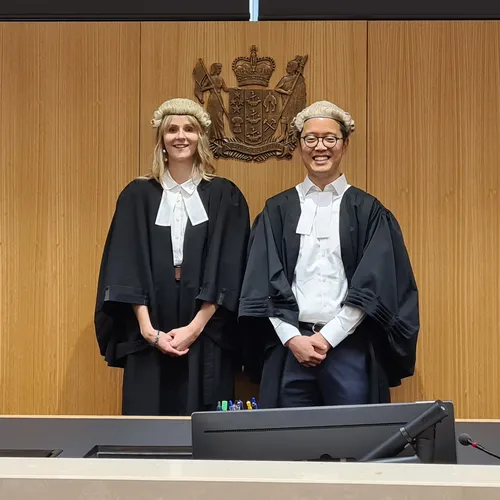
MyLaw is a New Zealand law firm with a focus on immigration law.
Our team is led by Michael Yoon, a New Zealand lawyer and member of the New Zealand Law Society.
He holds a current practising certificate and works across a range of immigration matters, from Parent Residence Visa matters to complex cases involving prior refusals, character issues, and multi-visa strategies.
Get in touch.
If a Parent Resident Visa is on your family’s mind, a short initial discussion is usually the most useful next step. We can talk through where the application sits today, what the sponsor-side picture looks like, and whether the timing is right to submit an Expression of Interest or prepare for an Invitation to Apply window.
Contact us to arrange an initial discussion, or call the office during business hours. We help with applications at every level of complexity, and we are set up to work alongside other advisers where your family already has them in place.
