Couple on partnership-based AEWV pathway received a PPI letter questioning the genuineness of their relationship. Detailed response with 42 supporting exhibits resulted in approval without further information requested.
Bring your partner to New Zealand — and get the visa application right.
Whether your relationship history is clean and simple or scattered across countries and complicated by prior refusals, we help you prepare a Partnership Work Visa application that holds together under assessment.
The basics
A temporary work visa from Immigration New Zealand for the partner of a New Zealander, a qualifying work-visa holder, or an eligible student — granted on the basis of a genuine and stable relationship.
Purpose
Temporary work visa for partners of New Zealanders, qualifying work-visa holders, or eligible students.
Length of stay
Varies by variant and the supporting partner's status. Some variants attach conditions tied to the supporting partner's role or wage.
Work rights
Generally permits open employment in New Zealand, limited study, and multiple travel in and out of the country during validity.
Alternatives
Three: Partner of a New Zealander, Partner of a Worker, Partner of a Student. The right one depends on your supporting partner's exact status.
Dependency
Dependent children are not automatically covered. They apply separately under a Dependent Child Visitor or Dependent Child Student Visa, depending on circumstances.
Residency pathway
Not a residence pathway unless the supporting partner is a New Zealand citizen or resident.
Not sure which variant fits?The right variant depends on your partner's exact status — and the rules attached to it shift. Talk to us before you start so we can match the variant to your situation.
Living together in New Zealand — working, signing a lease, building the kind of daily life that only happens when you are both in the same place — is what most couples are trying to get to when they reach this page.
When our help makes a difference
Some immigration processes are approved without much friction. Some situations carry real risk of delay, hard pushback or decline.
Real cases · Illustrative
Every case is different. These are illustrative and don't guarantee a particular outcome.
Avoidable problems
Visitor Visa applications can be declined or delayed for reasons that are sometimes avoidable with better preparation.
Weak ties to a home country, inconsistent travel history, or vague explanations of the purpose of a visit can raise concerns. A well-prepared application addresses these points directly with supporting evidence.
Bare-minimum bank balances, unclear income sources, or missing sponsorship documentation can lead to requests for further information or decline.
Applicants from countries without a low TB incidence may need a chest X-ray. Those with criminal history may need police certificates. Out-of-date evidence delays processing.
Your passport must be valid for at least three months beyond your planned departure date. Travelling on a passport close to expiry can result in being refused boarding or refused entry at the border.
Providing false, misleading, or incomplete information — even unintentionally — can result in decline, and may affect future visa applications.
Applying too close to your intended travel date, or failing to apply for an extension before your current visa expires, creates complications that are difficult to resolve.
Important constraints
The Partnership Work Visa is a temporary work visa for partnership relationships. If your relationship type, intended outcome, or family arrangements sit outside that, a different visa applies.
Not permitted
Applying under the wrong category wastes time and money. We'll tell you up front if a different visa fits your situation better.
Live in New Zealand permanently as a partner
Not a residence pathway, if the sponsoring partner is not a NZ citizen or resident visa holder.
Apply through a culturally arranged marriage
Assessed under a different framework — the Culturally Arranged Marriage Visitor Visa — with its own eligibility and evidence rules.
Include dependent children on the same application
Children apply separately. See Dependent Child Student Visa or a Dependent Child Visitor Visa.
Where the supporting partner's situation doesn't qualify
Depending on the skill level, pay rate and other factors, you may not be eligible.
Apply when you already hold New Zealand residence or citizenship
You don’t need this visa. Speak with us if you’re unsure which option applies.
Find the right pathway
If a different immigration process fits your situation, we can take you there directly.
Working with us
We will guide you step by step on your Partnership Work Visa process, from start to finish.
Short email discussion to understand the relationship history, the supporting partner's status, and any issues that may affect the application. We'll tell you up front which variant fits and whether the evidence is in workable shape.
Letter of engagement signed, invoice paid. We open the file, set the timeline against any current visa expiry, and map the evidence work ahead.
We build the shared timeline, gather the joint-life evidence INZ expects for your variant, identify and explain any gaps, and prepare the supporting documents — so the application reads as one coherent story before it reaches INZ.
We file the application on your behalf and confirm receipt with Immigration New Zealand.
If INZ requests further information, asks for an interview, or schedules a home visit, we prepare you and handle the response. You're not facing INZ alone.
We walk you through the outcome. If granted, we explain the conditions and what comes next — including the residence track if that's where you're heading. If declined, we look at reconsideration, a fresh application, or a different visa route.
FAQ
Professional support for a Partnership Work Visa application starts well before lodgement — and that preparation is where it matters most. We review your evidence against the specific criteria an immigration officer will assess, confirm the right variant applies, make sure the supporting partner’s declaration is consistent with your own documents, and identify areas that may attract further questions. For applications involving a supporting partner whose eligibility is borderline, a cohabitation history across several countries, a prior refusal on either side, or a short remedy window after a decline, that structured review shapes how the file reads to the assessing officer. Even where the facts appear straightforward on paper, having the evidence bundle reviewed as one coherent file — rather than a stack of separate documents — helps ensure the application presents your relationship clearly and completely.
That depends on your supporting partner. If they are a New Zealand citizen or resident, the Partner of a New Zealander Work Visa is usually the right product. If they hold an eligible work visa — AEWV, Essential Skills, Straight to Residence, Specific Purpose, Care Workforce Work to Residence, Transport Work to Residence, or Migrant Exploitation Protection — the Partner of a Worker Work Visa is the likely route. If they are enrolled in qualifying tertiary study (generally NZQCF Level 9 or 10, or Level 7 or 8 on the Green List or Post Study Work Visa eligible list), the Partner of a Student Work Visa is the one to consider. Borderline cases — short work visas, study levels that fall outside those lists, or recent changes in status — are common, and variant routing is one of the first things we work through with you.
We generally begin with an initial discussion to understand your situation and the variant that likely applies. From there we move through an eligibility review, evidence preparation, the supporting partner’s Form INZ 1146, lodgement through Immigration Online, and any follow-up with Immigration New Zealand. Where interviews, home visits, variations of conditions, or decline remedies come into play, we handle those as they arise. The sequence stays the same; the amount of work inside each step varies with your circumstances.
Immigration New Zealand may issue a request for further information — often described as a Section 158 request in the temporary visa context — when it wants additional documents or clarification before making a decision. When that happens we work with you to prepare a targeted response that addresses the specific points raised, rather than resubmitting the whole file. Responding well to these requests often resolves the matter without a decline, but the response has to be accurate and consistent with what was already lodged.
Several remedies may be available, and which one applies depends on the visa and the reason for decline. For a temporary visa, a reconsideration request can generally be made within 14 days of the decision. For residence decisions, an appeal to the Immigration and Protection Tribunal may be available within 42 days. If you have become unlawful, a Section 61 request may be possible, and in narrow circumstances a Ministerial Special Direction can be sought. Each pathway has its own window and its own evidence logic. The windows are tight, so a decline is a moment to act rather than regroup — but it is not always the end of the matter. The dedicated service pages for Section 61 requests and Immigration and Protection Tribunal appeals cover those remedies in more detail.
Yes. When the supporting partner changes employer, extends their work visa, moves to a different tertiary course, or transitions from study into work, your Partnership Work Visa often needs a variation of conditions or a fresh application to stay aligned with their status. We advise on which of those is required in your case, and prepare the necessary documentation. For Partner of a Worker clients, we also look at how the supporting partner’s role and wage band interact with the work-rights conditions that took effect in late 2024, because those conditions can shift when the supporter’s job changes.
Fees depend on the complexity of the matter. Straightforward applications are usually handled on a fixed-fee basis so you know the cost before we begin. More complex files — those involving character issues, prior refusals, or reconsideration and Tribunal work — are generally quoted individually or handled on an hourly basis within a scoped estimate. We discuss fee structure at the initial meeting before any engagement begins, and we do not start billable work until the scope is agreed.
Yes. Partnership Work Visa applications can be lodged onshore or offshore through Immigration Online, and we work with clients in both positions. Offshore matters generally involve more coordination around time zones, document certification, and police certificates from multiple jurisdictions, but the process and our role in it are much the same. We can discuss the practical logistics at the initial meeting.
This is a common situation rather than an unusual one. Genuine relationships often produce imperfect paper trails — shared addresses without both names on the tenancy, finances managed through one partner’s account, or periods apart where communication was casual rather than documented. The work in those files is reconstruction and framing: pulling together contemporaneous records, statutory declarations from people who knew you as a couple, and a timeline that explains gaps on its own terms. We cannot invent evidence, but we can help you present what genuinely exists in a form that reads coherently.
Whether your immigration process is straightforward or involves complicating factors, we can help you understand your options and put your best case forward.
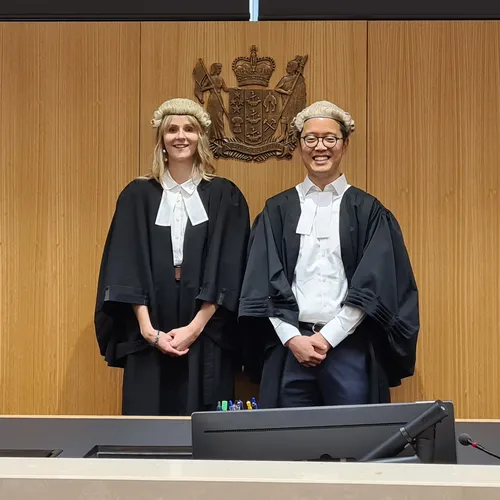
MyLaw is a New Zealand law firm with a focus on immigration law.
Our team is led by Michael Yoon, a New Zealand lawyer and member of the New Zealand Law Society.
He holds a current practising certificate and works across a range of immigration matters, from Partnership Work Visa matters to complex cases involving prior refusals, character issues, and multi-visa strategies.
If you are preparing a Partnership Work Visa application — or dealing with a request for further information, a decline, or a change in your partner’s circumstances — contact us for an initial discussion. We can review which variant applies, what evidence you have, and what the next steps look like.
If you would rather start by mapping your evidence before you get in touch, the Partnership Evidence Planner above is a useful first step.
